

A practical guide to target-account mapping, executive invitation strategy and attendance planning. Explain how guest relevance and a pitch-free agenda make the experience worth attending. For Clavent, the value of an executive event lies in the quality of the room: the relevance of the guests, the usefulness of the discussion and the trust created by the format.
That is why executive roundtable guest acquisition should be treated as a strategic channel, not a standalone tactic. The best programs connect account priorities, guest curation, event design and post-event follow-up so the experience creates momentum after the event itself.
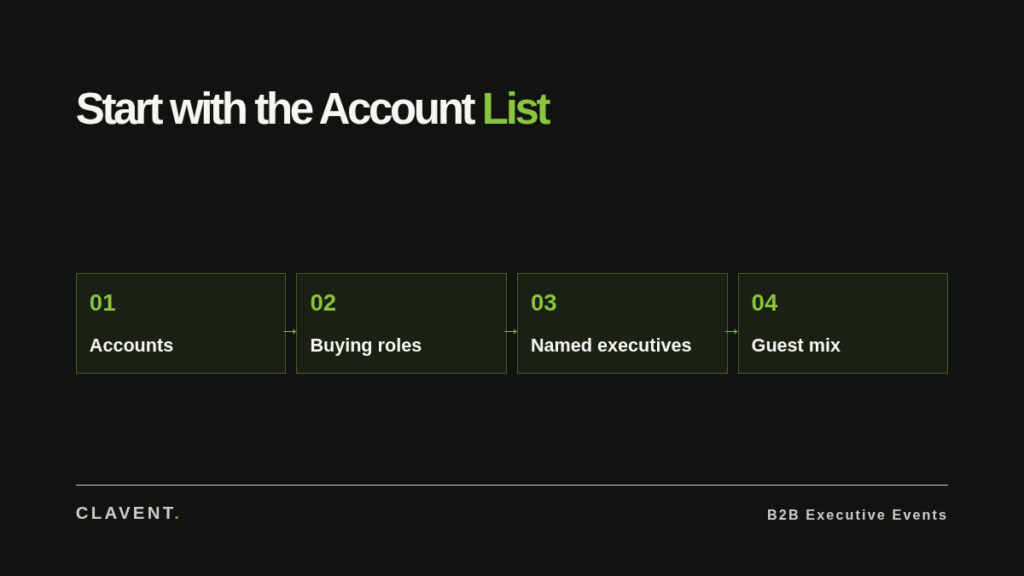
1. Start with target accounts, not an open registration page
Begin with a named-account list or a tightly defined audience universe instead of a broad sign-up page. Executive events work best when the guest list is curated around the accounts, industries or buying groups that matter most to the business objective.
That shift changes how the team plans the experience. Rather than asking who is available to attend, the better question is which relationships would create the highest value if they were in the room together.
2. Identify relevant CXO and VP personas
Relevance at the persona level is essential. A CFO, CMO, CIO and business-unit leader may all sit inside the same account, but they will only accept the invitation if the topic reflects the decisions they actually influence.
Map the problem statement to the seniority and function you want in the room. When the theme, participants and outcomes feel aligned, attendance quality improves and the discussion becomes more valuable for everyone involved.
3. Build an agenda around a shared business challenge
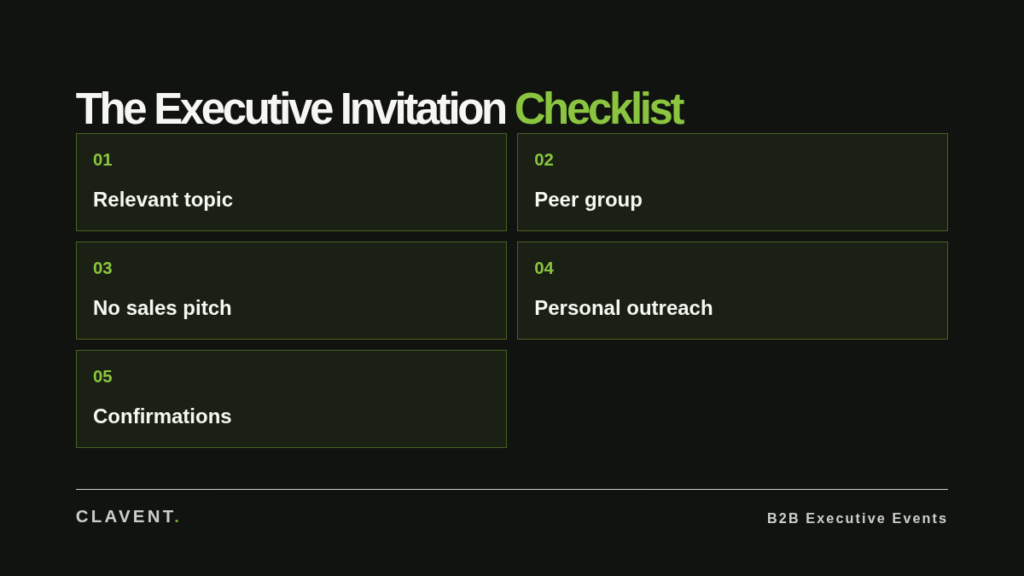
The agenda should revolve around a shared challenge, not a disguised product presentation. Executive guests respond better to a problem-led discussion that helps them benchmark thinking and exchange perspectives with peers.
That is where Clavent’s pitch-free approach creates an advantage. The host still earns visibility and credibility, but the format keeps the conversation open, trusted and genuinely worth joining.
4. Use personalized outreach and confirmation follow-through
Relevance at the persona level is essential. A CFO, CMO, CIO and business-unit leader may all sit inside the same account, but they will only accept the invitation if the topic reflects the decisions they actually influence.
Map the problem statement to the seniority and function you want in the room. When the theme, participants and outcomes feel aligned, attendance quality improves and the discussion becomes more valuable for everyone involved.
5. Measure target-account coverage and attendance
Measurement should connect event activity to account progress. Useful indicators include target-account coverage, seniority of attendees, quality of conversations, introductions generated and the progression of post-event follow-up.
Avoid relying on vanity numbers alone. For executive programs, depth of engagement and next-step momentum are usually more meaningful than raw volume.
Conclusion
Executive events work best when every decision — from audience selection to post-event follow-up — supports a clear business objective. For brands that want stronger conversations with senior decision-makers, a curated, pitch-free format gives relationships room to develop.
Planning an executive roundtable? Share your target audience and event objective with Clavent.